Elevate your cooking with Culinary Herbs
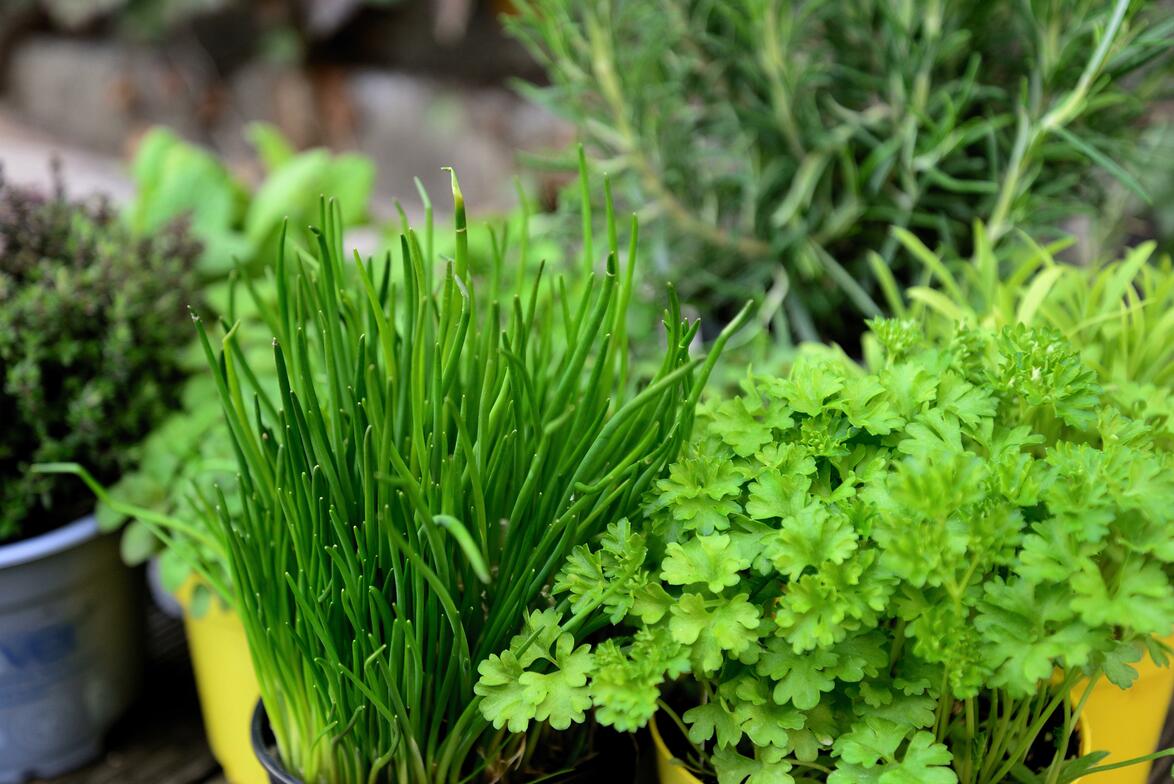
An extensive variety to complement cuisines from around the world will be available at the St. Jude’s Annual Plant Sale, Saturday, May 9th, from 8:30 to 11:00.
Every spring I look forward to purchasing my regular selection of Culinary Herbs to make my cooking that much more special. For example, I use whole springs of Rosemary to tuck into a lamb & potato braise at the beginning of a low, slow simmer. Or roll up leaves of fresh, brilliant green Basil into a cigar shape and cut crosswise into thin strips ( known as a “chiffonade”) to scatter over a grilled pizza made with tomato sauce and fresh mozzarella cheese. Yummy!
Both of those herbs I highlighted, Rosemary and Basil, are integral to the Mediterranean style of cooking. They are both highly aromatic and release their essential oils when rubbed. But that is where the similarity ends. Rosemary is a woody herb: it requires full sun, defined as a minimum of 6 hours of sun a day, should be planted in light soil in a pot with good drainage, and should not be overwatered - water only when the top 1” inch of soil is dry to the touch. It thrives in conditions where other woody Mediterranean herbs grow, like the warm climate, soft winds and sandy soil of the South of France or Italy. Other herbs in the woody family are Thyme, Oregano and Sage. They are considered perennials (as in, they can come back every year), but I prefer to start fresh with new pots from the St. Jude’s Plant Sale - they are given the right start with the right soil and are disease free.
Basil belongs to the soft or leafy category of Mediterranean Culinary Herbs and are primarily used fresh in a salad or added at the end of cooking to retain their bright green colour and delicious taste. To encourage a bushy Basil plant, you will need to prune the plant when 6” tall, cutting at a 45 degree angle just above a leaf node. (There are plenty of YouTube videos illustrating the right approach). Also, a flowering Basil plant will not produce anymore of those delicate and delicious leaves, so you will need to deadhead the Basil plant if you want to make late season pesto. And you should!
Like Italian Parsley (bright & refreshing, used fresh as a garnish or in salads like Lebanese Tabbouleh) and French Tarragon (anise or licorice flavour, delicious in salad dressings or classic French dishes such as Béarnaise sauce or Lobster Thermidor), almost all parts of these annual plants can be used, including the stems. In contrast to the woody variety of herbs, leafy herbs can successfully be grown in partial shade. If it is very hot, move the pots to a shady spot to keep the leaves from wilting. Moist soil is best, akin to a wrung out sponge.
I must make special mention of a perennial herb that fellow Garden Guild member, Donna Young, has introduced to many curious gardeners at the St. Jude’s Plant Sale. It is Lovage, a perennial, native to Afghanistan and Iran, but spread to Europe in the Middle Ages. There, the leaves are used as a herb, the roots as a vegetable and the seeds as a spice. It tastes like a combination of celery and parsley and can be used in recipes where those flavours are celebrated such as soups, stews, salads and stuffings as well as savoury drinks like a Caesar. She plants Lovage directly into her veggie garden where it thrives with full sun.
Pots of Herbs at the St. Jude’s Plant Sale are so varied and plentiful that I always want to buy more than my herb garden trolley can hold! We recently relocated from a house with a garden to a condo with a balcony, but I did not want depend on the local grocery store to have a ready, unblemished supply of my favourites. More importantly, there is something deeply satisfying and evocative of warm Southern European terraces about caressing a Basil bush that you have planted yourself or rubbing Rosemary between your fingers before you carefully snip off a woody sprig or two. So every day I water each Herb pot according to its needs and move my garden trolley around to catch (or avoid) the sun. See you at the Sale!